PFAS
What are PFAS?
PFAS is a large group of fluorinated substances, of which PFOS is one of the best known. They are water-, stain-, and grease-repellent and are used "everywhere". PFAS has been used for over 50 years in a range of products, including food packaging, nonstick coatings in pots and frying pans, impregnating agents for textiles, firefighting foam, cleaning products, cosmetics, paint, varnish, and certain types of ski wax.
There is growing concern about PFAS because the substances break down very slowly in nature, tend to spread in the environment, accumulate in living organisms, and may be harmful to health. Since 2001, Avinor has used PFOS-free firefighting foam and since 2012 has used firefighting foam completely without fluorinated compounds. As a single measure, this is one of the most important things Avinor has done to reduce PFAS leaching. Internationally, there are airports that still use PFAS-containing extinguishing foam. Historical use has led to contamination in the ground at Avinor’s airports, and this still contributes to some PFAS leaking into the natural areas around the airports.
In Avinor’s climate and environmental strategy from 2023, a long-term goal was adopted that “Avinor shall contribute to the national objective of reducing PFAS emissions,” and a short-term goal to “Clean up PFAS-contaminated areas in accordance with orders from the Norwegian Environment Agency.” In practice, the short-term goal means that cleanup of PFAS-contaminated sites at two airports per year is to be carried out in the period 2023–2027. This will be measured with two KPIs:
- Number of sites (airports) where measures have been implemented.
- Amount of PFAS (kilograms) removed from circulation through removal or spread-reducing measures.
Avinor has established a dedicated PFAS program responsible for mapping, preparing action plans, and cleanup in accordance with orders from the Norwegian Environment Agency. The basis for the program’s work is that the total PFAS emissions from Avinor’s airports shall be reduced as far as possible (cf. requirements in the order from the Norwegian Environment Agency). The objective is to remove PFAS, or reduce its spread, from the most contaminated areas at 13 prioritized airports by 2027. The prioritization is based on the summary report from 2019 prepared pursuant to an order from the Norwegian Environment Agency. The figure below shows measures carried out so far at Avinor’s sites (Figure 1).
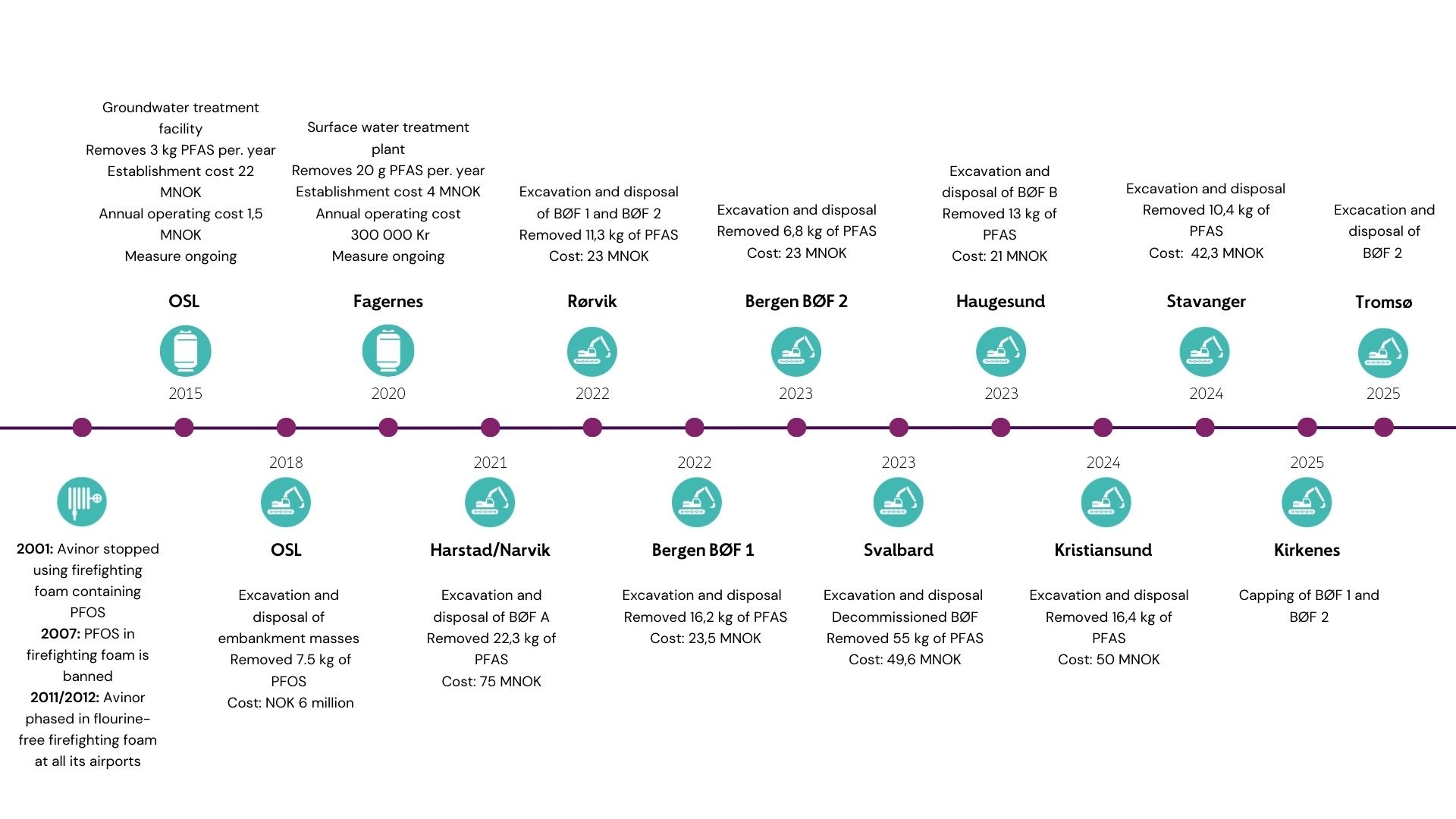
The measures carried out so far (including ongoing work in 2025) at the aforementioned airports have removed or reduced the spread of 245 kilograms of PFAS, mainly through excavation and disposal (Figure 2). All masses have been delivered to a landfill with special permission to receive PFAS-contaminated material.
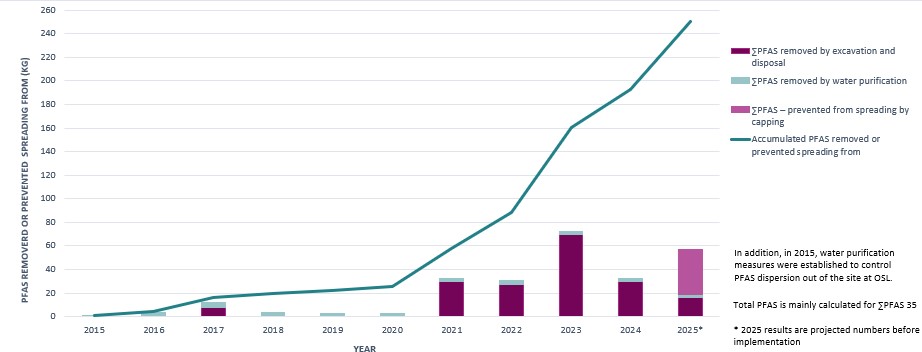
Avinor is also working to increase its own knowledge of new and relevant remediation methods for PFAS-contaminated soil and/or water. Avinor’s goal is to be able to use other measures than those used so far (water treatment/excavation and disposal), so that the cleanup can be carried out more cost-effectively without compromising environmental effectiveness.
Avinor has an accounting provision intended to reflect the expected costs associated with the work on, and cleanup of, PFAS-contaminated sites. The provision is subject to significant uncertainty and is updated continuously as new knowledge becomes available. Changed requirements, threshold values, and framework conditions from the authorities could affect the costs associated with PFAS work. As of Q2 2025, the provision is NOK 775 million.