Climate

Greenhouse gas emissions are a global problem and lead to irreversible climate change. By 2050, the world must be an almost zero-emission society for the goals of the Paris Agreement to be achieved. This requires extensive emissions-reducing measures in all sectors, including aviation. The largest aviation-related greenhouse gas emissions come from air traffic itself, followed by passengers' and employees' transport to and from airports (access transport) and, finally, greenhouse gas emissions associated with airport operations.
Aviation connects Norway together - but we must cut emissions quickly. That is why Avinor has set ambitious climate goals: Avinor will cut its own greenhouse gas emissions by 42% by 2030 and help ensure that Norwegian aviation achieves the common goal of being fossil-free by 2050.
Greenhouse gas emissions from air traffic
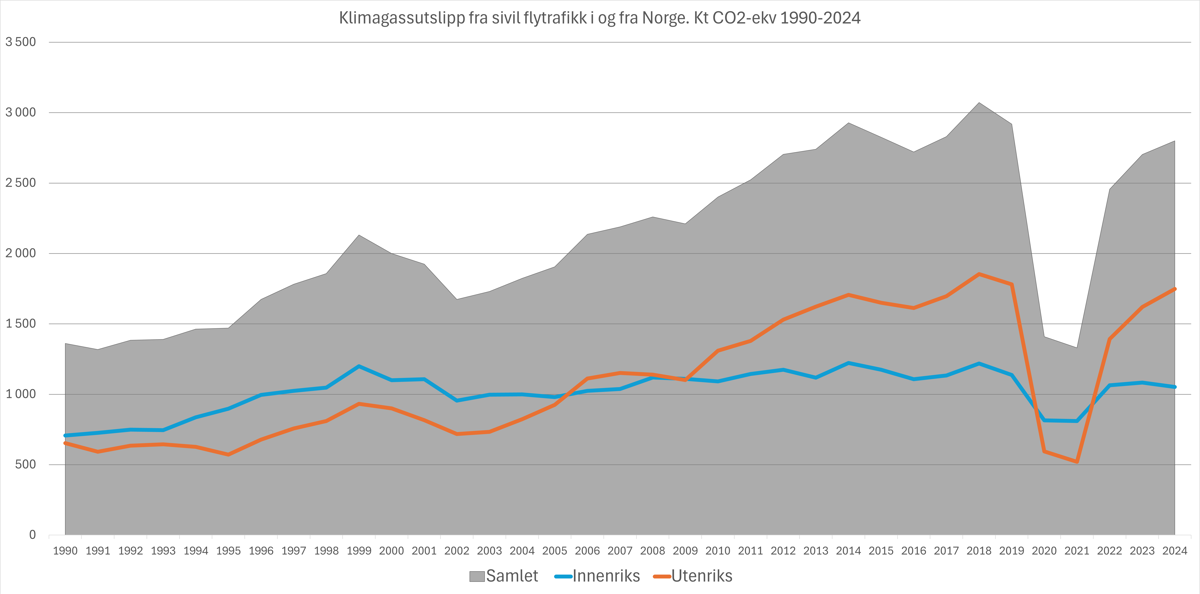
The greenhouse gas emissions from all domestic civil aviation corresponded, according to Statistics Norway (SSB), in 2024 (the latest official figures) to 2.3 percent of total domestic emissions (1.05 out of a total of 44.6 million tonnes of CO2 equivalents). Emissions from domestic traffic have been relatively stable over the past 25 years, despite significant growth in traffic. These are the emissions covered by the Kyoto Protocol and reported in SSB’s statistics on greenhouse gas emissions from Norwegian territory. This principle is applied in all countries.
Greenhouse gas emissions from international traffic, that is, from Norwegian airports to the first destination abroad, amounted in 2024 to 1.75 million tonnes of CO2 equivalents. These emissions are reported annually by the Norwegian Environment Agency to the United Nations Framework Convention on Climate Change (UNFCCC). Emissions from international traffic have grown significantly since 1990. This is due to far more travelers, but also more direct routes from Norway.
Total greenhouse gas emissions from all jet fuel for civil purposes sold at Norwegian airports in 2024 (the latest official figures) corresponded to about 5 percent of Norway’s total emissions, on the order of 2.8 million tonnes of CO2 equivalents, when international shipping is also included. Emissions in 2024 were back at the levels from 2013 and 2014, but not quite as high as in the years immediately before the coronavirus pandemic.
Climate and Avinor
Avinor's own emissions
Here you can read about emissions from Avinor’s own operations – such as from vehicles and energy use.
Read moreEnergy
Here you can read about indirect greenhouse gas emissions from purchased energy, such as electricity and district heating.
Read moreEmissions from air traffic and the value chain
Here you will find information about airspace, sustainable aviation fuel, and zero- and low-emission aviation.
Read moreClimate risk
Here you can read about how Avinor is adapting its extensive building stock and other infrastructure to climate change.
Read more