Test projects
See how new aviation technology is tested in practice – from initial demonstrations to operational experience. Through test projects in Norway as an international test arena, actors gain valuable insights into infrastructure, regulations, and operations, as well as a concrete foundation for further development and commercialization.
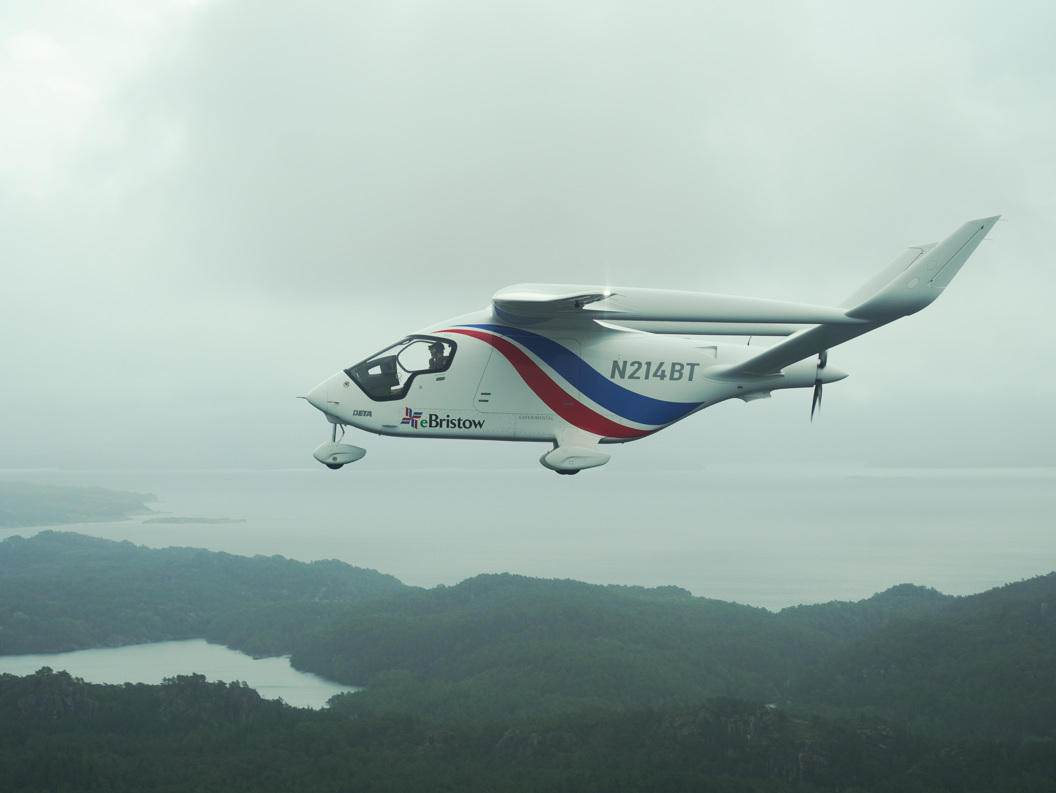
Freight route between Stavanger and Bergen
Who: Bristow Norway and BETA Technologies
Aircraft: BETA ALIA (CTOL - Conventional Take Off and Landing)
Duration of test period: 6 months
Purpose: Learn through practical operations: how electric aircraft function in an operational aviation system, with weather, winter conditions, air traffic control, safety requirements, and daily operations.
Objective: Provide authorities, airports, and operators with concrete insight into needs related to charging infrastructure, procedures, emergency preparedness, and future training.
Number of flights: 126
Total distance flown: 8,748 nautical miles (16,201 km)
Energy charged: 12 MWh
Airports visited in addition to regular flights between Stavanger and Bergen: Haugesund, Stord, Kristiansand, Arendal, and Florø.
Kristiansand, Arendal, and Florø.
About the project
Test Arena Norway has now completed its very first test project - and it marks an important milestone for the future of aviation.
In January 2026, the electric aircraft ALIA from BETA Technologies landed in Stavanger after around six months of operational testing in Norway. With that, the project, carried out in collaboration between Bristow Norway, BETA Technologies, Avinor and the Civil Aviation Authority, was officially concluded.
The project is the first to be carried out under Test Arena Norway, and has provided valuable experience with what is actually required to take electric aviation from concept to practical operation.
Avinor: Infrastructure for the next generation of aviation
For Avinor, the project has been an important arena for building experience in how airports must be developed to accommodate new types of aircraft.
-As an airport operator, Avinor has a clear responsibility to prepare our infrastructure for the next generation of aviation. Through this project, we have gained concrete experience in how we should develop airports and charging infrastructure for the future.
— Karianne Helland Strand, Executive Vice President for Sustainability and Infrastructure at Avinor
The Civil Aviation Authority: Regulatory learning in practice
The Civil Aviation Authority has used the project to develop regulatory frameworks and an initial version of a “sandbox environment” for new technology - so that innovation can take place safely and in a controlled manner.
-We have established an initial version of a regulatory sandbox environment and can now assess how the different safety rules function in the context of this new technology concept.
— Jan Petter Steinland, Director of Strategic Analysis and Transformation, the Civil Aviation Authority
An important part of the work has also been close dialogue with air traffic control services, which has shown that electric aircraft can be integrated into today’s airspace without major changes.
Bristow and BETA Technologies: One step closer to commercial electric aviation
The partners point to the project as an important first step toward future operations with zero-emission aircraft.
-This project represents an important step toward the next generation of aviation.
— Dave Stepanek, Executive Vice President and Chief Transformation Officer, Bristow Group
-The project has shown exactly how electric aviation should be introduced - with a planned, safe approach in close partnership with authorities, operators, and airports.
— Simon Newitt, Head of Sales & Support, BETA Technologies
Lessons before the next phase
The project has also identified key needs for the next phase, including more robust charging systems, winter-adapted infrastructure, and training for fire and rescue services related to battery technology and alternative fuels.
This first project shows how Norway, as an international test arena, can help bring new aviation technology from idea to operational reality - and provides a solid foundation for further testing and development in the years ahead.
New projects
New projects in Norway as an international test arena are currently in contract negotiations and will be announced when the negotiations have been completed.